
Courses
Etude de textes litteraires de la langue d'étude - Dr Mehdaoui
Compréhension et expression ecrite - Dr Drissi
Compréhension et l'Expression Orale Dr. Mohamed Hadji
Course Summary
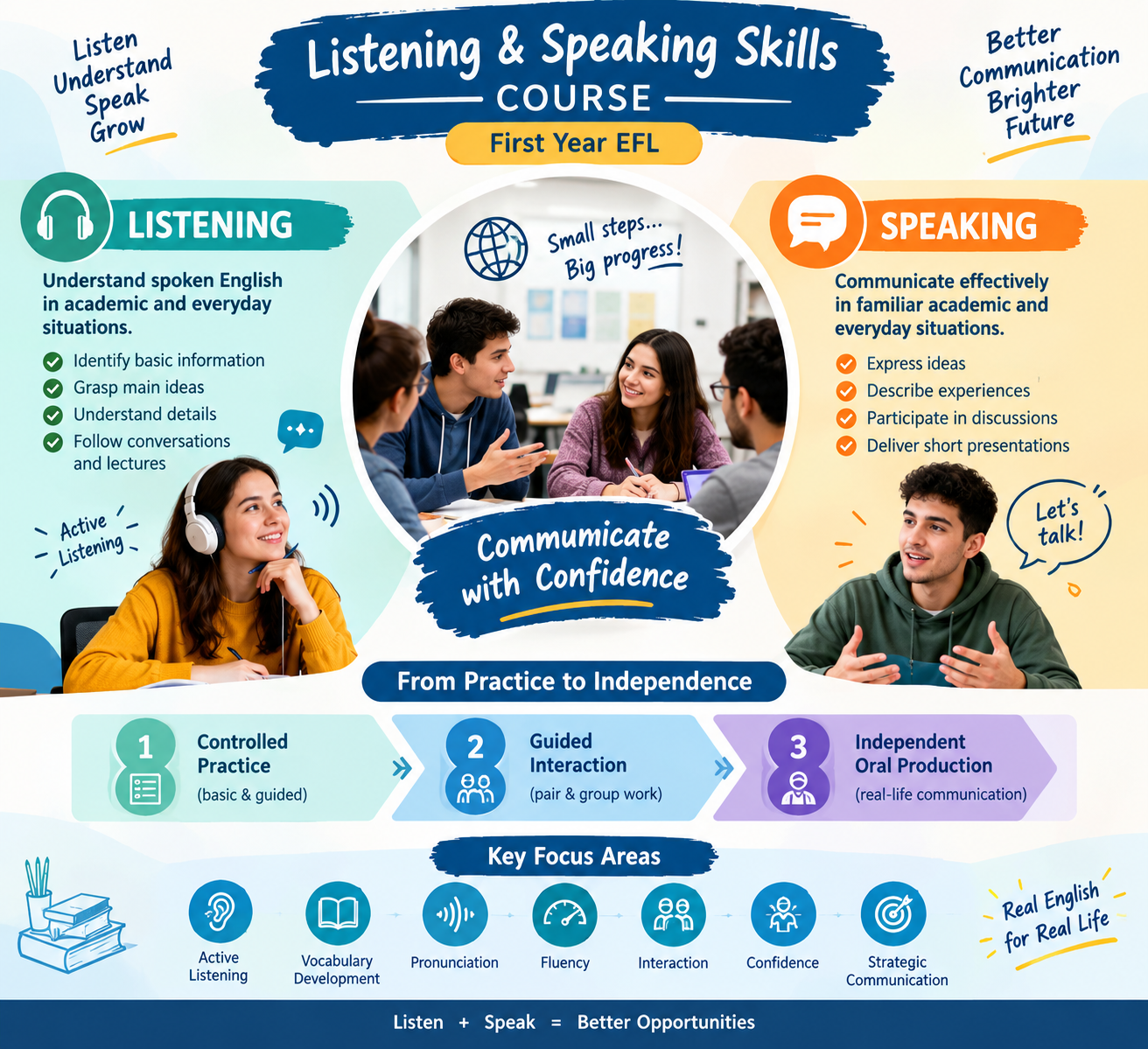
The Listening and Speaking Skills course is designed to develop first-year EFL students’ receptive and productive oral communication skills in familiar academic and everyday contexts. The course integrates listening comprehension, spoken interaction, pronunciation, vocabulary development, and oral production through a range of culturally relevant themes and communicative tasks.
The listening component focuses on helping students understand spoken English at progressively increasing levels of complexity. Students are trained to identify main ideas and supporting details, recognize specific information, infer meaning from context, follow spoken discourse, take effective notes, and respond appropriately to different types of oral input. Particular attention is given to features of natural spoken English, including contractions, connected speech, signposting expressions, stress, rhythm, and pronunciation.
The speaking component develops students’ ability to communicate ideas clearly and confidently through pair work, discussions, problem-solving activities, role plays, short presentations, and classroom interaction. Students are encouraged to move from controlled practice towards more independent oral production while developing fluency, accuracy, intelligibility, and interactional competence.
The course adopts an integrated and learner-centered approach in which listening and speaking are treated as complementary processes. Students are encouraged to use strategies before, during, and after listening and to transform information received through listening into meaningful spoken responses. Activities progressively develop learners’ ability to understand, process, negotiate, organize, and communicate meaning in English.
The thematic content, including school life and educational systems around the world, provides meaningful contexts for language use while simultaneously promoting cultural awareness and intercultural understanding. Through repeated cycles of preparation, listening, analysis, practice, interaction, production, and reflection, students gradually develop greater confidence and autonomy as users of spoken English.
Core Competencies
By the end of the course, students are expected to demonstrate improved ability to:
- Understand the main ideas and essential details of spoken texts;
- Recognize common organizational and signposting features of spoken discourse;
- Apply effective listening and note-taking strategies;
- Understand selected features of natural spoken English;
- Participate appropriately in interpersonal and academic conversations;
- Express and organize ideas coherently in spoken English;
- Use appropriate vocabulary, grammar, pronunciation, and discourse strategies;
- Respond to and interact with other speakers effectively;
- Demonstrate increased fluency, confidence, and communicative autonomy.
Overall, the course aims to move students from comprehension to interaction and from guided practice to increasingly independent oral communication, establishing a foundation for successful academic and professional use of English.
Techniques du travail universitaire / Study Skills
Moving from high school to university requires students to be independent, autonomous and active learners because they are shifting from the stage of being passive recievers of information who consider their teachers as the soul source of knowdge to engaged learners who contribute to their learning process. Therefore, being a university student is a skill that has to be associated with other skills: time management, self-discipline, organisation, memorization, location and readiness to achieve the learning goals.
Grammar 1
This Grammar module aims to develop students’ knowledge and practical use of fundamental English grammatical structures. It covers the main parts of speech, including nouns, verbs, pronouns, adjectives, adverbs, prepositions, and conjunctions. Students will study sentence elements such as sentences, clauses, and phrases; nouns and pronouns, including singular and plural forms, countable and uncountable nouns, group and pair nouns, quantifiers, personal, possessive, and reflexive pronouns; adjectives and adverbs, including comparison, frequency, place, time, manner, and degree; as well as quantifiers and prepositions. Through explanations, examples, and practical exercises, students will develop greater grammatical accuracy and confidence in using English.