
Dr. Moulay Tahar University, Saida
Faculty of Letters, Languages and Arts
Department of English Language and Literature
Educational Psychology
Lecturer: Dr. Bouaricha Level: M1
Academic Year: 2024-2025
Introduction to Educational Psychology
Lesson 1: The Scope of Educational Psychology
Part I: Defining the Core Areas
Educational Psychology is a highly applied discipline that draws upon several foundational areas of general psychology. For the Didactician, these areas represent the primary levers for analyzing, designing, and optimizing the teaching-learning process (Slavin, 2020).
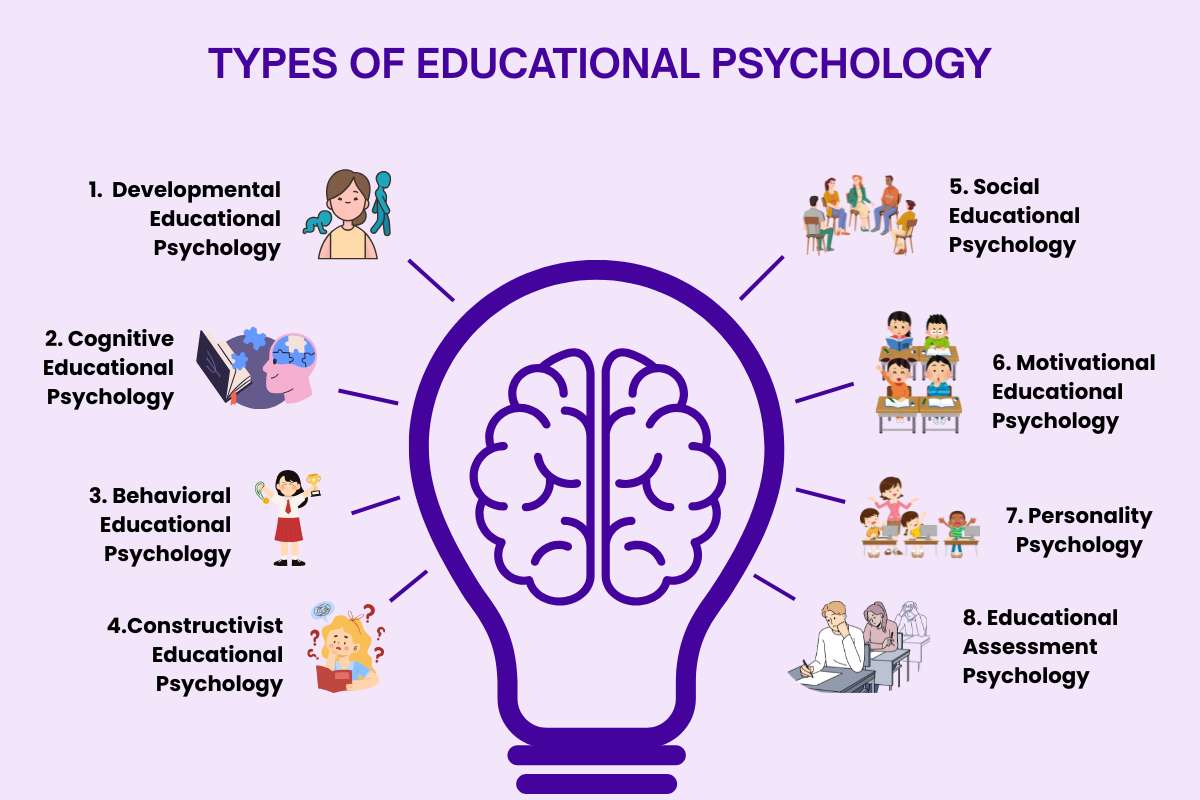
The scope can be segmented into eight critical areas of study, each linked to prominent figures:
1. Developmental Educational Psychology
· Key Theorists: Jean Piaget (cognitive stages) and Lev Vygotsky (sociocultural theory).
· Focus: The study of systematic changes in the learner’s capabilities—cognitive, physical, and socio-emotional—across the lifespan (Santrock, 2018).
· Relevance to Didactics: Ensures that curriculum design and teaching methods are appropriate for the learner’s current stage of development.
2. Cognitive Educational Psychology
· Key Theorists: Jerome Bruner (discovery learning and scaffolding) and Robert Gagné (conditions of learning).
· Focus: The internal mental processes involved in learning, including attention, memory, problem-solving, and metacognition. The learner is viewed as an active information processor (Woolfolk, 2019).
· Relevance to Didactics: Informs strategies for improving information encoding, storage, and retrieval, leading to instructional techniques like scaffolding (Bruner).
3. Behavioral Educational Psychology
· Key Theorists: B.F. Skinner (operant conditioning) and Edward Thorndike (Law of Effect).
· Focus: The study of observable behavior and how it is influenced by external environmental factors, such as rewards and consequences.
· Relevance to Didactics: Provides the scientific basis for classroom management systems, behavior modification techniques, and the use of positive reinforcement schedules (Skinner).
4. Constructivist Educational Psychology
· Key Theorists: Jean Piaget, Lev Vygotsky, and John Dewey (experiential learning).
· Focus: The theory that learners actively build (construct) their own understanding and knowledge through experience and social dialogue.
· Relevance to Didactics: Justifies the implementation of student-centered methods like project-based learning and collaborative group tasks (Slavin, 2020). Vygotsky's Zone of Proximal Development (ZPD) is a core construct here.
5. Social Educational Psychology
· Key Theorist: Albert Bandura (Social Cognitive Theory and Observational Learning).
· Focus: The influence of the social and cultural context on learning, including peer relationships and group dynamics.
· Relevance to Didactics: Essential for fostering an inclusive, supportive learning environment. Bandura's modeling concepts are crucial for demonstrating appropriate academic and social behavior.
6. Motivational Educational Psychology
· Key Theorist: Albert Bandura (Self-Efficacy Theory) and Carol Dweck (Mindset Theory).
· Focus: The study of the factors that energize, direct, and sustain behavior towards academic goals (Woolfolk, 2019).
· Relevance to Didactics: Guides the design of tasks that increase student engagement, persistence, and self-regulation. Teachers can build a student's self-efficacy (Bandura) by ensuring early successes.
7. Personality Psychology
· Key Figures: Often draws on the work of humanistic and trait theorists.
· Focus: Examining the role of consistent individual differences (traits, temperament, values) on learning styles and adaptation to the educational setting.
· Relevance to Didactics: Informs the need for differentiated instruction and helps teachers understand the roots of student variation.
8. Educational Assessment Psychology
· Key Theorist: Benjamin Bloom (Taxonomy of Educational Objectives).
· Focus: The development, use, and interpretation of measurement tools (tests, rubrics) to evaluate learning, diagnose difficulties, and assess program effectiveness.
· Relevance to Didactics: Ensures that evaluation methods are valid, reliable, and fair. Bloom's Taxonomy provides a framework for setting hierarchical learning goals.
Academic References
Santrock, J. W. (2018). Educational psychology (6th ed.). McGraw-Hill Education.
Slavin, R. E. (2020). Educational psychology: Theory and practice (13th ed.). Pearson.
Woolfolk, A. (2019). Educational Psychology (14th ed.). Pearson.