Topic outline

  • Welcome

    • Welcome to Your Artificial Intelligence & Machine Learning Course
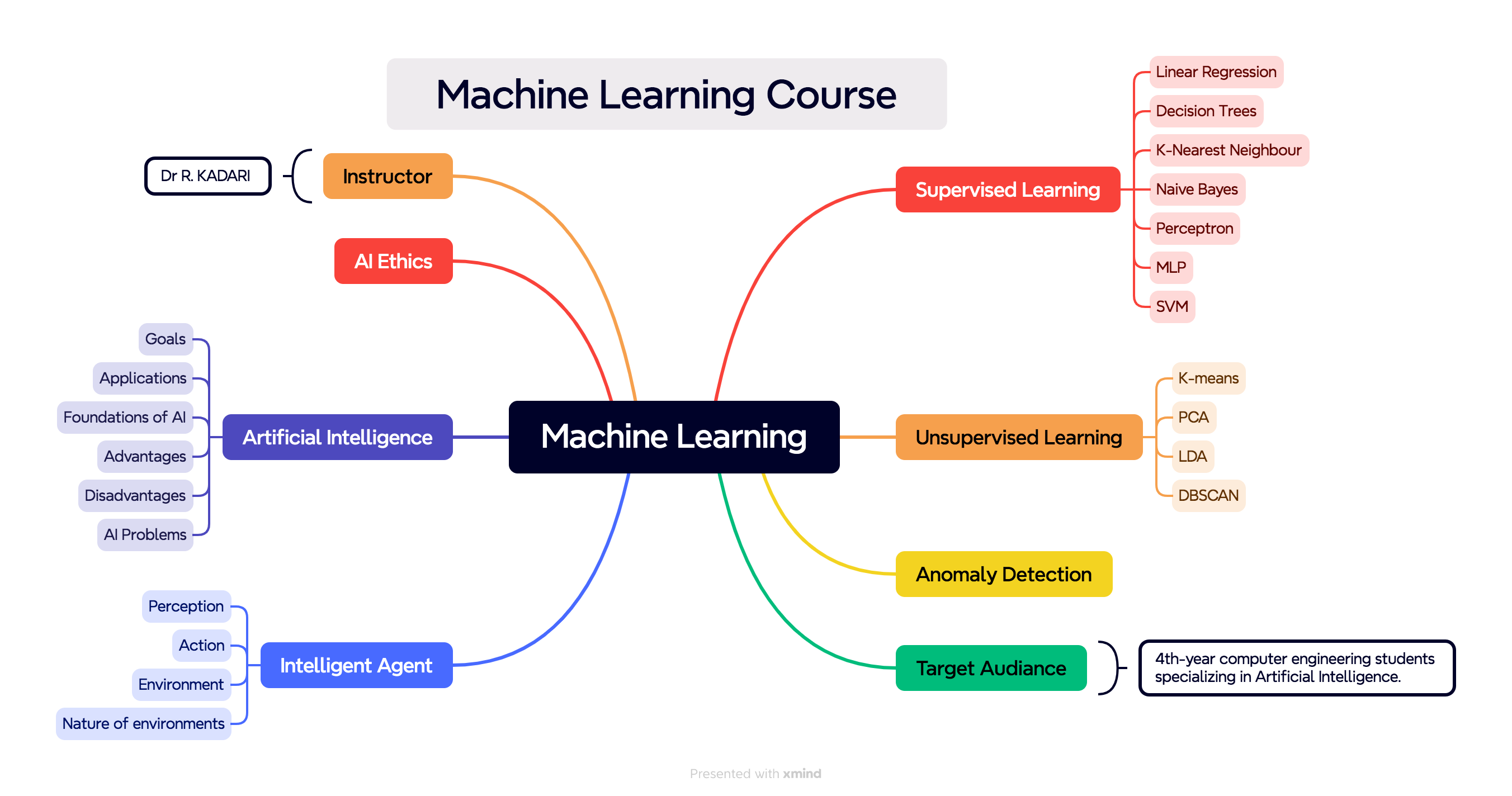
      DD

  • Contact Information

    • Faculty: MIT
      Departement: Mathematics
      Course title :  Artificial Intelligence & Machine Learning
      Target audience: 1st year PhD Students
      Duration: 14–16 weeks
      Schedule: Monday, 08:30–11:30
      Room: Reyadh Campus
      Instructor:
      Lecture : Dr. Rekia KADARI
      Contact: by email at rekia.kadari@univ-saida.dz
      Availability:
      Forum response: Any question about the course must be posted on the dedicated forum so that all students can benefit from the answer. I commit to responding to questions posted within 48 hours.
      By email: I commit to replying to emails within 72 hours of receiving the message, except in case of unforeseen circumstances.

  • General Objectives of the Course

    • At the end of this course, the student should be able to:

      • Understand the key principles and algorithms of machine learning.

      • Distinguish between supervised, unsupervised, and reinforcement learning approaches.

      • Apply appropriate algorithms to solve classification, regression, and clustering problems.

      • Evaluate and interpret model performance using standard metrics.

      • Implement machine learning solutions using programming tools such as Python and relevant libraries.

      • Critically analyze the strengths, limitations, and ethical implications of machine learning systems.

      Target Audience

      This course is designed for 1st-year phD students of Applied Mathematics.

  • Prerequisite Test

    • Opened: Tuesday, 10 March 2026, 12:00 PM
      Closes: Friday, 1 May 2026, 12:05 PM
  • Artificial Intelligence and Intelligent Agents

  • The Core Idea Behind Machine Learning

  • Linear Regression

  • Decision Trees

    • Opened: Tuesday, 17 March 2026, 12:00 AM
      Due: Tuesday, 5 May 2026, 12:00 AM
    • Opened: Sunday, 12 April 2026, 3:00 PM
      Closes: Friday, 1 May 2026, 3:05 PM
    • References

      • Tan, P.-N., Steinbach, M., & Kumar, V. (2018). Introduction to Data Mining (2nd Edition). Pearson.
      • Hastie, T., Tibshirani, R., & Friedman, J. (2009). The Elements of Statistical Learning (2nd Edition). Springer.
      • James, G., Witten, D., Hastie, T., & Tibshirani, R. (2021). An Introduction to Statistical Learning (2nd Edition). Springer.
  • K-Nearest Neighbour

    • Opened: Tuesday, 17 March 2026, 12:00 AM
      Due: Friday, 1 May 2026, 12:00 AM
    • Opened: Sunday, 12 April 2026, 3:10 PM
      Closes: Friday, 1 May 2026, 3:16 PM
    • References

      • Tan, P.-N., Steinbach, M., & Kumar, V. (2018). Introduction to Data Mining (2nd Edition). Pearson.
      • Hastie, T., Tibshirani, R., & Friedman, J. (2009). The Elements of Statistical Learning (2nd Edition). Springer.
      • James, G., Witten, D., Hastie, T., & Tibshirani, R. (2021). An Introduction to Statistical Learning (2nd Edition). Springer.
  • Naive Bayes

    • Opened: Tuesday, 17 March 2026, 12:00 AM
      Due: Friday, 1 May 2026, 12:00 AM
    • Opened: Sunday, 12 April 2026, 3:15 PM
      Closes: Friday, 1 May 2026, 3:20 PM
    • References

      • Manning, C. D., Raghavan, P., & Schütze, H. (2008). Introduction to Information Retrieval. Cambridge University Press.
      • Hastie, T., Tibshirani, R., & Friedman, J. (2009). The Elements of Statistical Learning (2nd Edition). Springer.
      • James, G., Witten, D., Hastie, T., & Tibshirani, R. (2021). An Introduction to Statistical Learning (2nd Edition). Springer.
  • K-means

    • Opened: Tuesday, 17 March 2026, 12:00 AM
      Due: Friday, 1 May 2026, 12:00 AM
    • Opened: Monday, 13 April 2026, 2:00 PM
      Closes: Friday, 1 May 2026, 2:05 PM
    • References

      • Tan, P.-N., Steinbach, M., & Kumar, V. (2018). Introduction to Data Mining (2nd Edition). Pearson.
      • Hastie, T., Tibshirani, R., & Friedman, J. (2009). The Elements of Statistical Learning (2nd Edition). Springer.
      • James, G., Witten, D., Hastie, T., & Tibshirani, R. (2021). An Introduction to Statistical Learning (2nd Edition). Springer.
  • Perceptron

    • Opened: Monday, 13 April 2026, 2:07 PM
      Closes: Friday, 1 May 2026, 2:12 PM
    • References

      • Goodfellow, I., Bengio, Y., & Courville, A. (2016). Deep Learning. MIT Press.
      • Haykin, S. (2009). Neural Networks and Learning Machines (3rd Edition). Pearson.
      • Russell, S., & Norvig, P. (2021). Artificial Intelligence: A Modern Approach (4th Edition). Pearson.
  • Principal Component Analysis

  • DBSCAN - LDA

    • References

      • Ester, M., Kriegel, H.-P., Sander, J., & Xu, X. (1996). A Density-Based Algorithm for Discovering Clusters in Large Spatial Databases with Noise. In Proceedings of the 2nd International Conference on Knowledge Discovery and Data Mining (KDD ’96), 226–231.
      • Hastie, T., Tibshirani, R., & Friedman, J. (2009). The Elements of Statistical Learning (2nd Edition). Springer.
  • Support Vector Machines

  • Evaluation Metrics

  • Anomaly Detection

  • External Useful Ressources

  • External Python Ressources

  • Discussion Space

    • Welcome to the Discussion Space! This is your dedicated area to ask questions, share ideas, and engage with fellow learners. Here, you can:

      • Post questions about course topics or assignments.

      • Share insights, tips, or resources that may help others.

      • Participate in collaborative problem-solving and discussions.

      • Discuss real-world applications of concepts covered in the course.

    • Welcome to the Chat Space! This is a casual and interactive area for real-time conversations with your classmates and instructors. Here, you can:

      • Ask quick questions or get immediate help.

      • Share ideas, links, and resources informally.

      • Discuss course topics, projects, or related interests.

      • Collaborate and brainstorm in a friendly environment.

      Guidelines:

      • Keep discussions respectful and supportive.

      • Stay relevant to the course or learning topics.

  • Bibliographic References

      • Machine Learning: An Artificial Intelligence Approach (ISBN: 366212405X, 9783662124055)
      • Géron, A. (2022). Hands-on machine learning with Scikit- Learn, Keras, and TensorFlow: Concepts, tools, and techniques to build intelligent systems. ” O’Reilly Media, Inc.
      • Shinde, P. P., & Shah, S. (2018, August). A review of machine learning and deep learning applications. In 2018 Fourth international conference on computing communication control and automation (ICCUBEA) (pp. 1-6). IEEE.
      • ALPAYDIN, Ethem. Machine learning. MIT press, 2021.
      • LeCun, Y., Bengio, Y., & Hinton, G. (2015). Deep learning. nature, 521(7553), 436-444.
      • Bengio, Y. (2009). Learning deep architectures for AI. Foundations and trends® in Machine Learning, 2(1), 1-127