
Course Modules
Part 1
Introduction to Convex Programming
- Convex sets & functions
- Partial derivatives & gradient
- Lagrange multipliers
- Optimality conditions
Part 2
Frank-Wolfe Method
- Conditional gradient algorithm
- Linear approximation approach
- Convergence analysis
- Practical applications
Part 3
Kelley's Cutting Plane Method
- Piecewise linear models
- Iterative refinement
- Bundle methods
- Non-differentiable functions
Part 1: Introduction to Convex Programming
1️⃣ 1.1: What is Convex Programming?
📊 Definition
Convex programming is the study and solution of optimization problems where we seek to minimize (or maximize) a convex function over a convex set. The remarkable property of convex problems is that any local minimum is also a global minimum, making them tractable and solvable efficiently.
🎯 General Form
where \(f\) and \(g_i\) are convex functions, and \(h_j\) are affine functions (linear).
✅ Why Convexity is Revolutionary
Global Optimum
Any local minimum is a global minimum. No getting stuck in bad solutions!
Efficient Algorithms
Polynomial-time solvable. Real-world problems can be solved quickly.
Strong Theory
Well-understood mathematical properties. Duality theory, sensitivity analysis.
Wide Applications
Machine learning, finance, signal processing, control theory, and more.
2️⃣ 1.2: Convex Sets and Functions
📐 Convex Sets
📘 Definition
A set \(C \subseteq \mathbb{R}^n\) is convex if for any two points \(x, y \in C\) and any \(\lambda \in [0,1]\):
In simple terms: The line segment connecting any two points in the set remains entirely within the set.
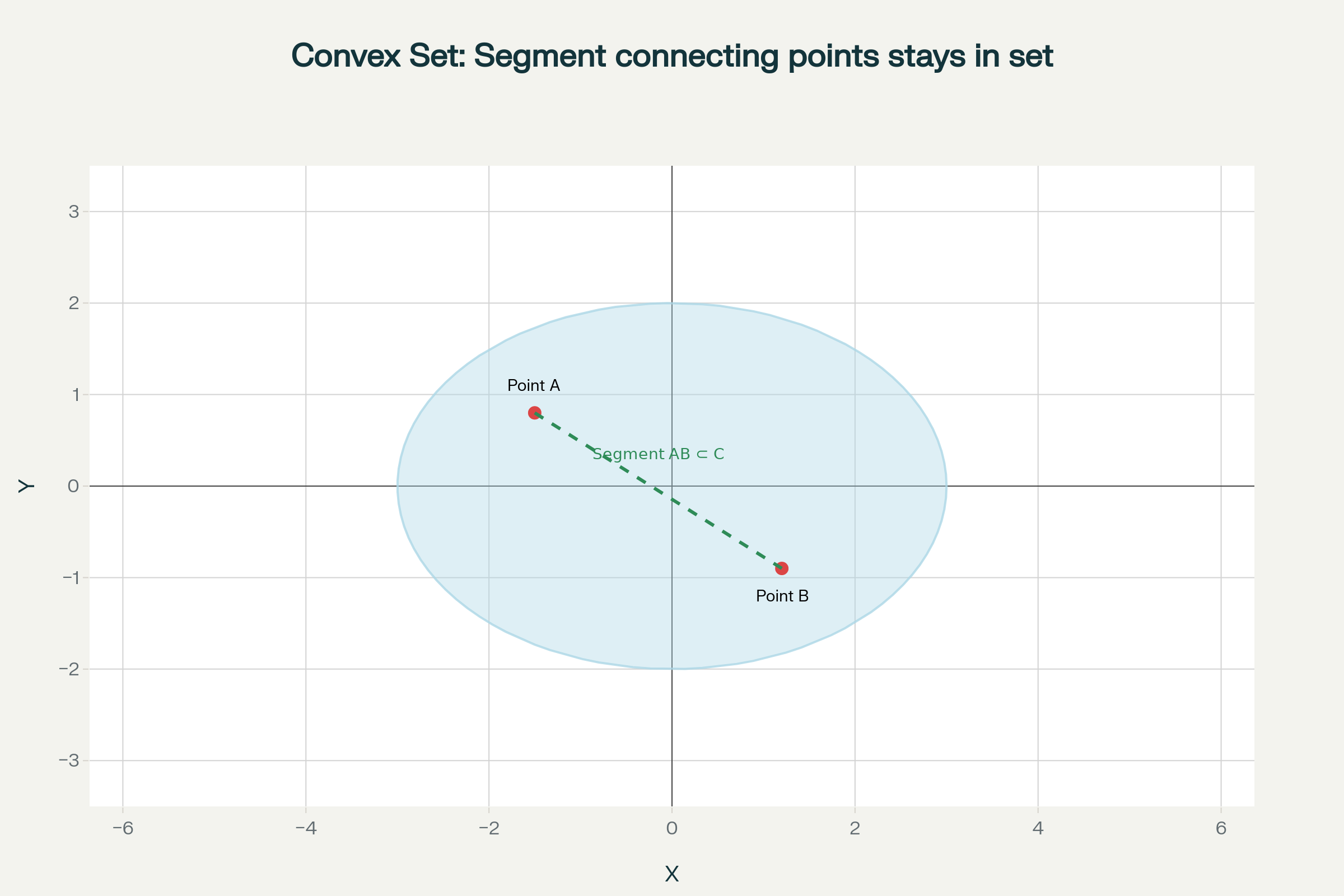
Figure 1: Illustration of a convex set. For all points A and B in C, the segment [AB] remains entirely in C.
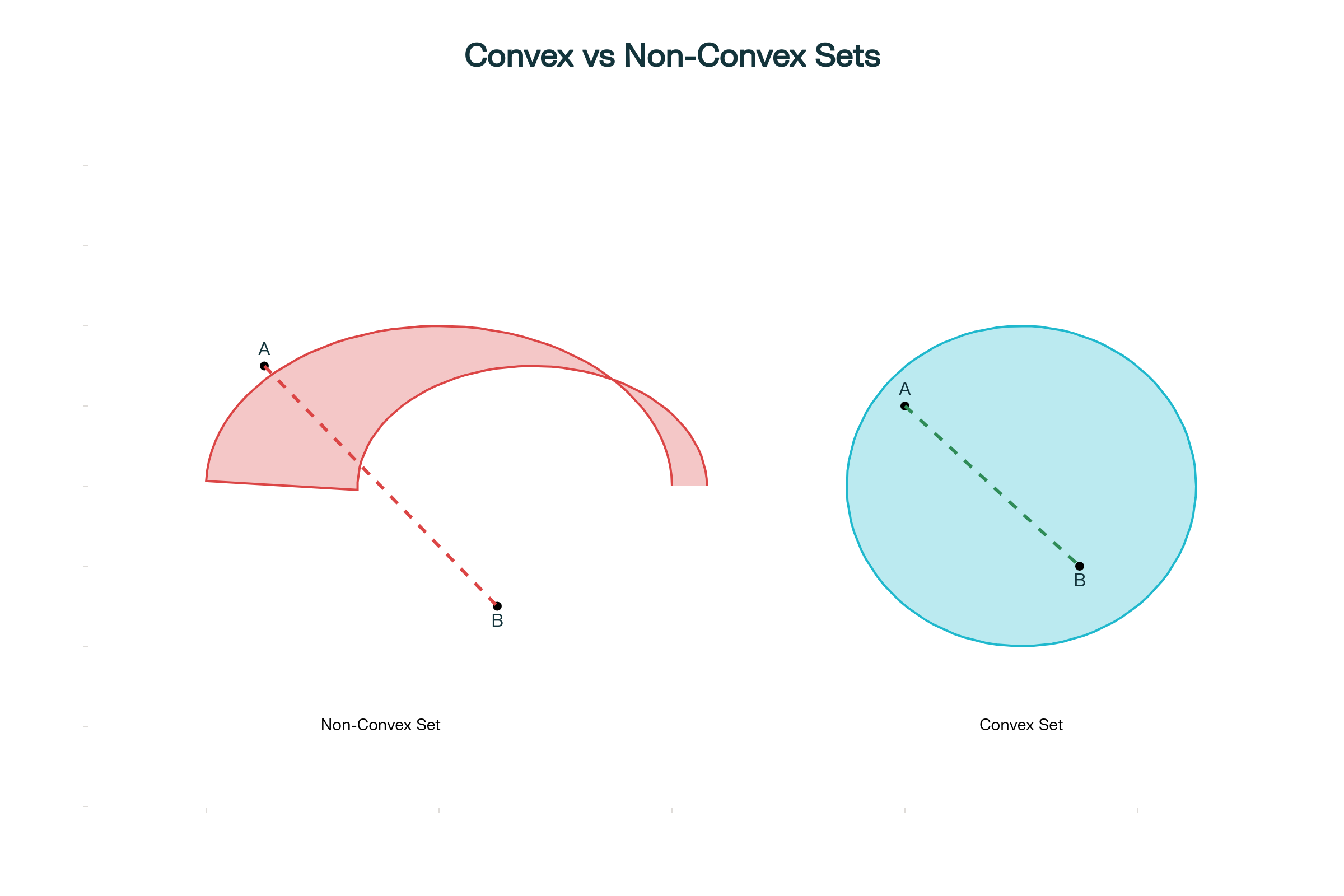
Figure 2: Comparison between convex and non-convex sets
💡 Examples of Convex Sets
- Empty set ∅ and singleton {x}: Trivially convex
- Euclidean space \(\mathbb{R}^n\): The entire space
- Halfspaces: \(\{x : a^Tx \leq b\}\)
- Polyhedra: Intersection of halfspaces
- Balls: \(\{x : \|x - x_c\| \leq r\}\)
- Ellipsoids: \(\{x : (x-x_c)^TP^{-1}(x-x_c) \leq 1\}\)
📈 Convex Functions
📘 Definition
A function \(f: \mathbb{R}^n \to \mathbb{R}\) is convex if its domain is convex and for any \(x, y\) in the domain and any \(\lambda \in [0,1]\):
Geometric interpretation: The chord connecting any two points on the graph of \(f\) always lies above (or on) the function curve.
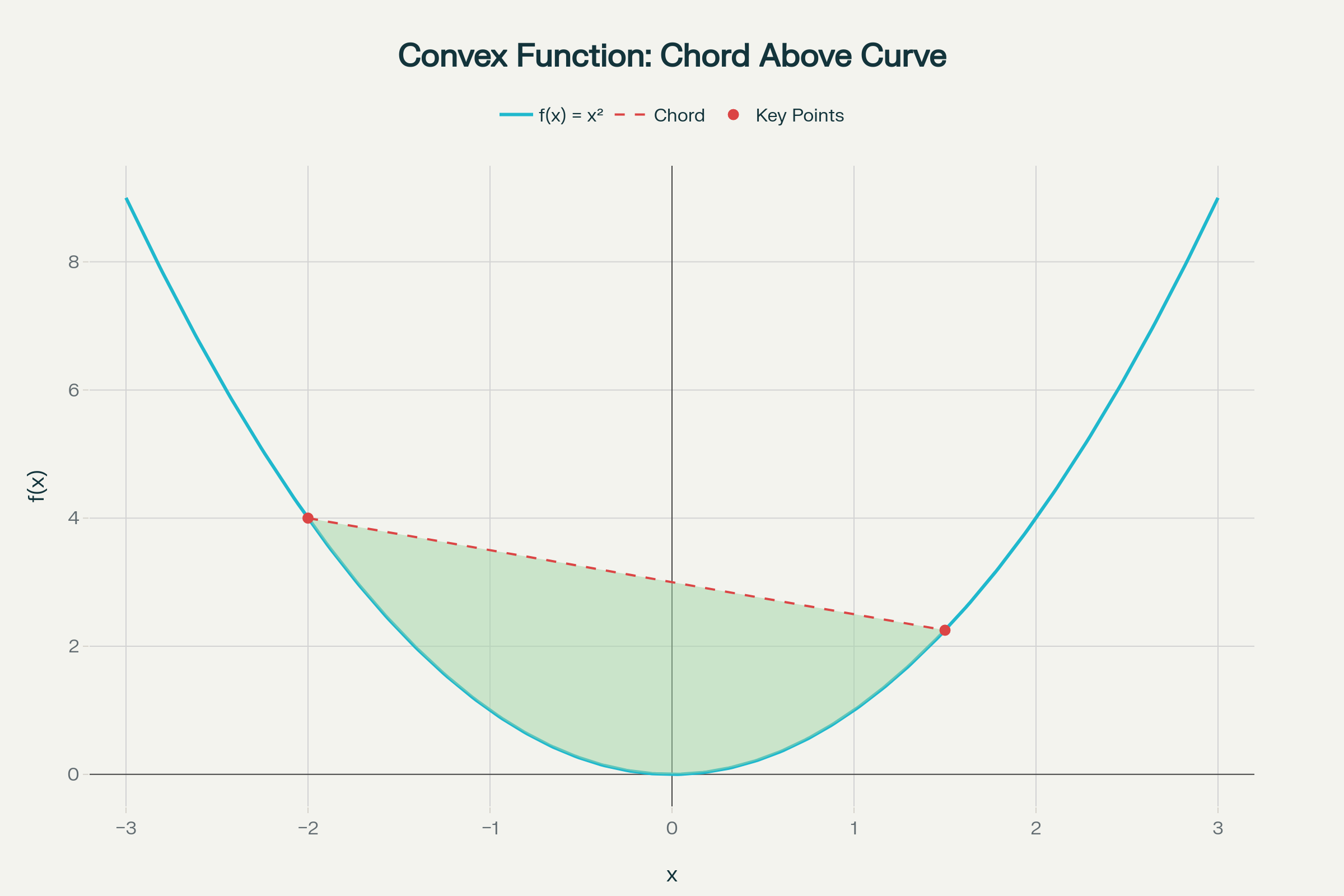
Figure 3: Convex function f. The chord (red segment) connecting two points always stays above or on the curve of f.
💡 Examples of Convex Functions
- Linear functions: \(f(x) = a^Tx + b\)
- Affine functions: \(f(x) = Ax + b\)
- Exponential: \(e^{ax}\) for any \(a \in \mathbb{R}\)
- Powers: \(x^a\) on \(\mathbb{R}_{++}\) for \(a \geq 1\) or \(a \leq 0\)
- Quadratic: \(\frac{1}{2}x^TQx + b^Tx + c\) where \(Q \succeq 0\)
- Norms: \(\|x\|_p\) for \(p \geq 1\)
- Maximum: \(f(x) = \max\{x_1, ..., x_n\}\)
🌐 Extension to Higher Dimensions
Convexity concepts extend naturally beyond 2D to higher dimensions, which is crucial for modern optimization applications.
📊 In dimension n
A set \(C \subseteq \mathbb{R}^n\) is convex if for all points \(x, y \in C\) and all \(\lambda \in [0,1]\), we have:
The definition remains identical—only the number of coordinates changes!
Examples in 3D
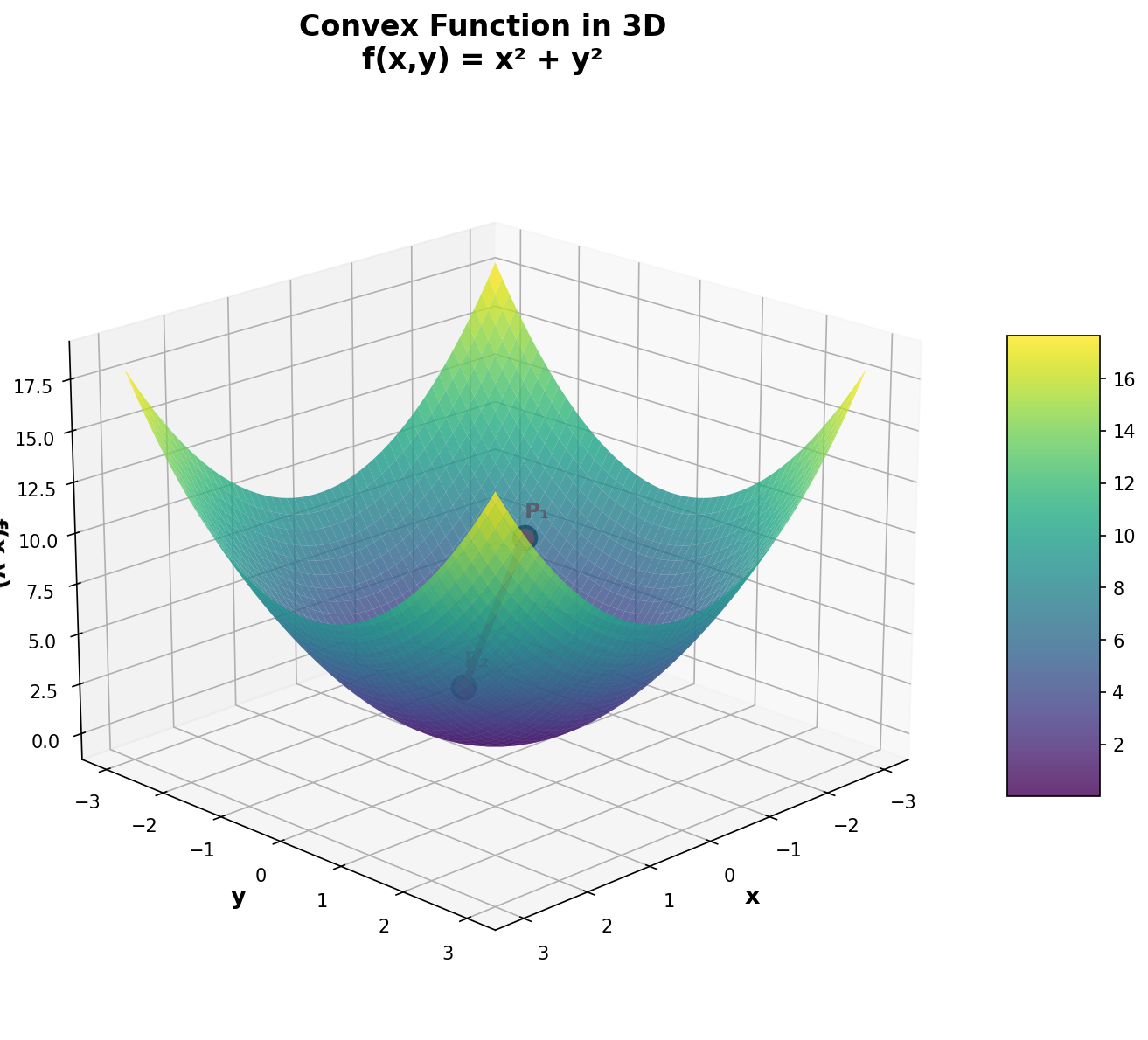
Figure 5: Convex function f(x,y) = x² + y² visualized in 3D
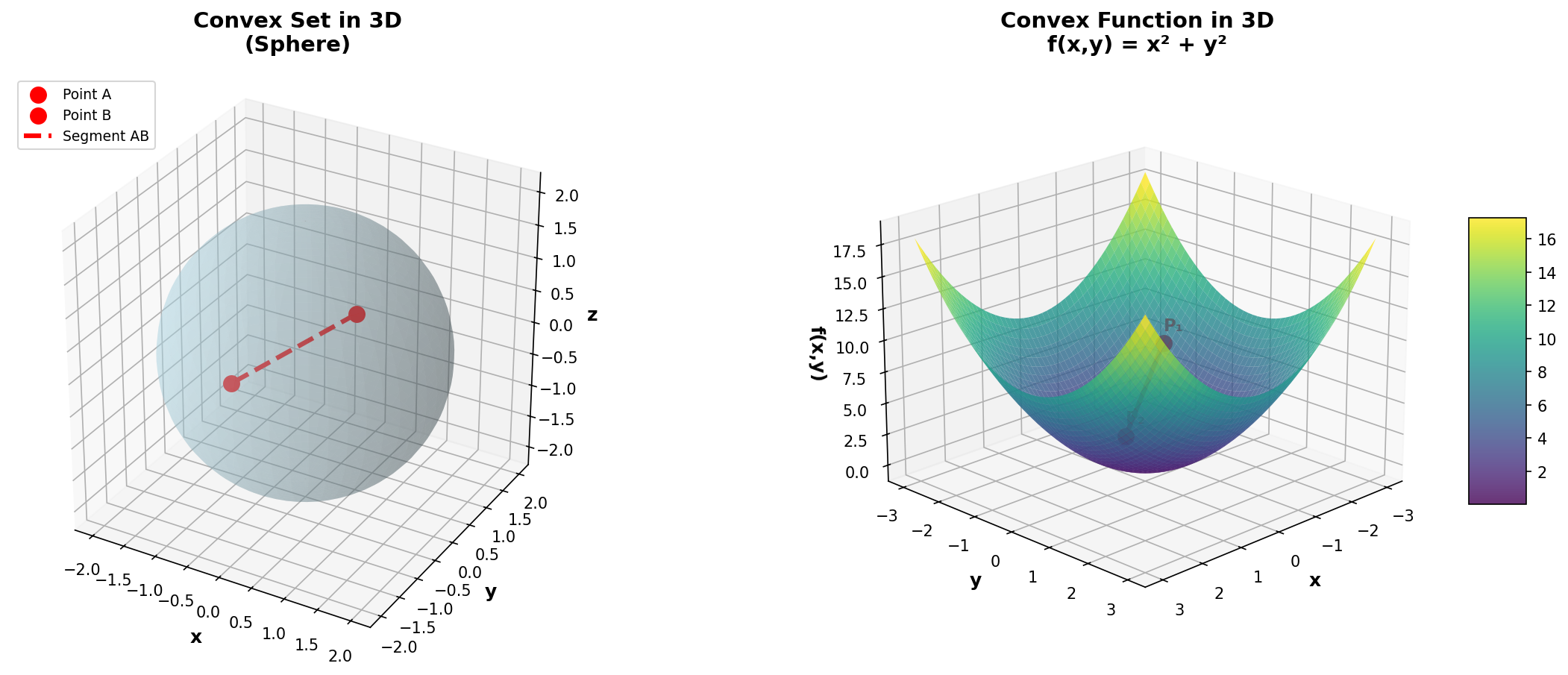
Figure 6: Left: 3D convex set (sphere) where the segment connecting two points remains in the set. Right: Convex function f(x,y) = x² + y² showing the chord above the surface.
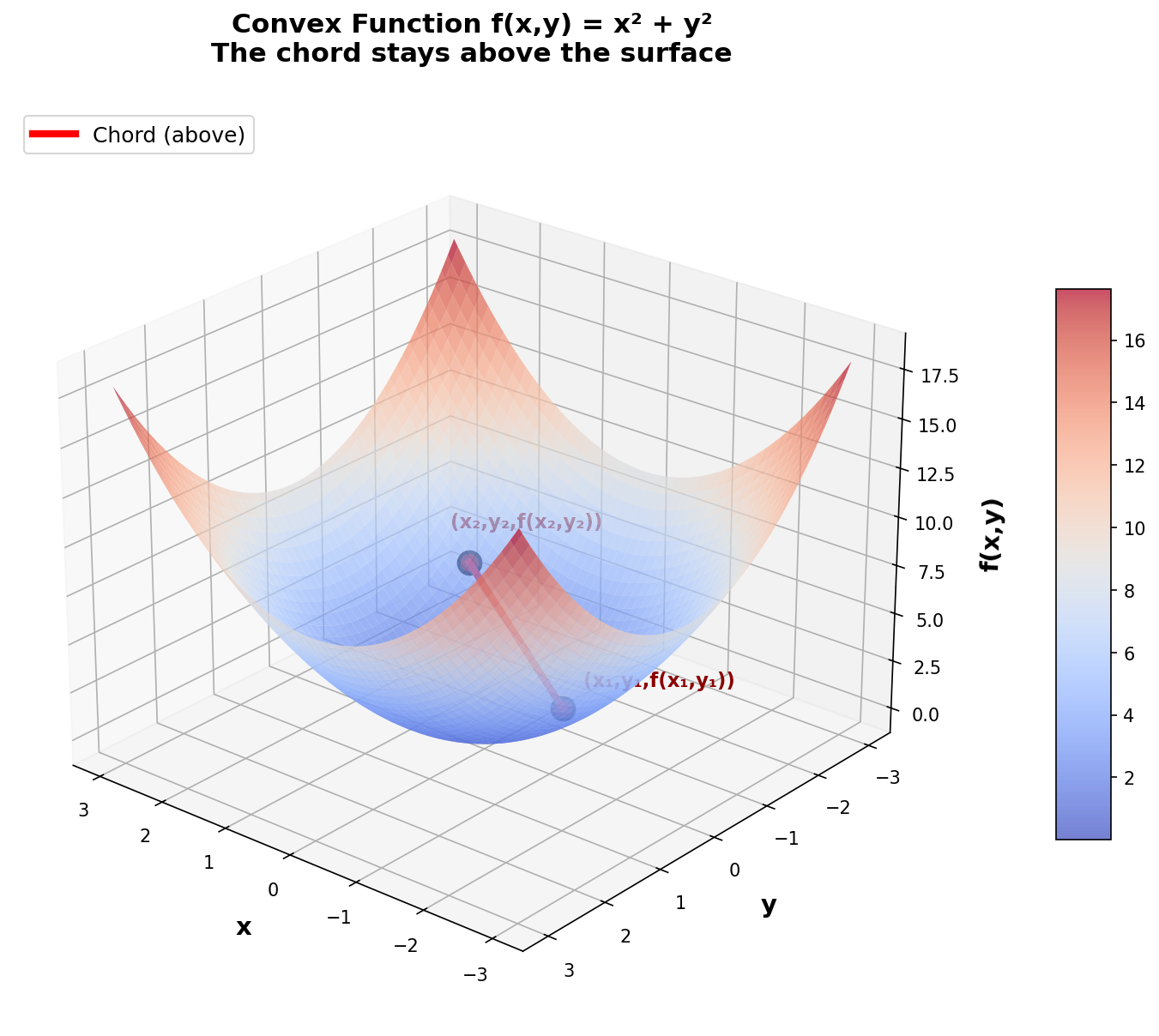
Figure 7: Detailed visualization of f(x,y) = x² + y². Green dashed lines show the vertical distance between the chord (red) and the surface, illustrating that the chord always stays above.
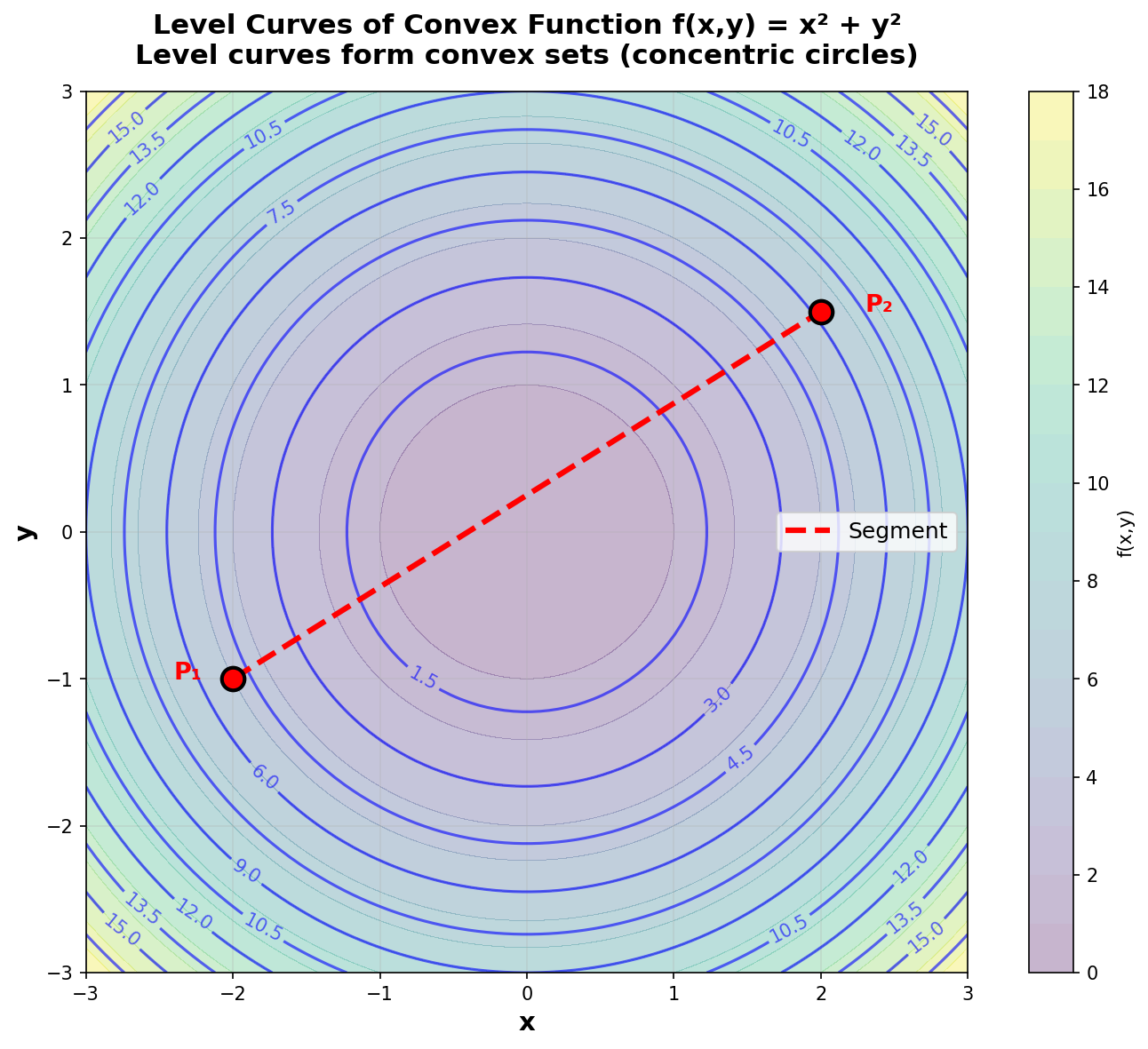
Figure 8: Level curves of f(x,y) = x² + y². The level curves of a convex function form convex sets (here, concentric circles).
🚀 Applications in High Dimensions
In practice, optimization problems often involve functions of hundreds, thousands, or even millions of variables:
- Machine Learning: Neural networks have millions of parameters
- Portfolio Optimization: Allocation across hundreds of assets
- Image Processing: Each pixel is a variable (millions of variables)
- Network Planning: Flow optimization on complex graphs
Even though we cannot visualize high-dimensional spaces, the mathematical properties of convexity (notably the uniqueness of the global minimum) remain valid and guarantee that optimization algorithms will converge to the optimal solution.
3️⃣ 1.3: Fundamental Mathematical Tools
Before addressing optimality conditions and algorithms, it is essential to understand three key mathematical concepts: partial derivatives, the gradient, and Lagrange multipliers. These tools are at the heart of all optimization theory.
📐 Partial Derivatives
📘 Definition
For a function of several variables \(f(x_1, x_2, ..., x_n)\), the partial derivative with respect to a variable measures how the function changes when we vary that variable while keeping all other variables fixed.
Alternative notation: \(\partial_i f\) or \(f_{x_i}\)
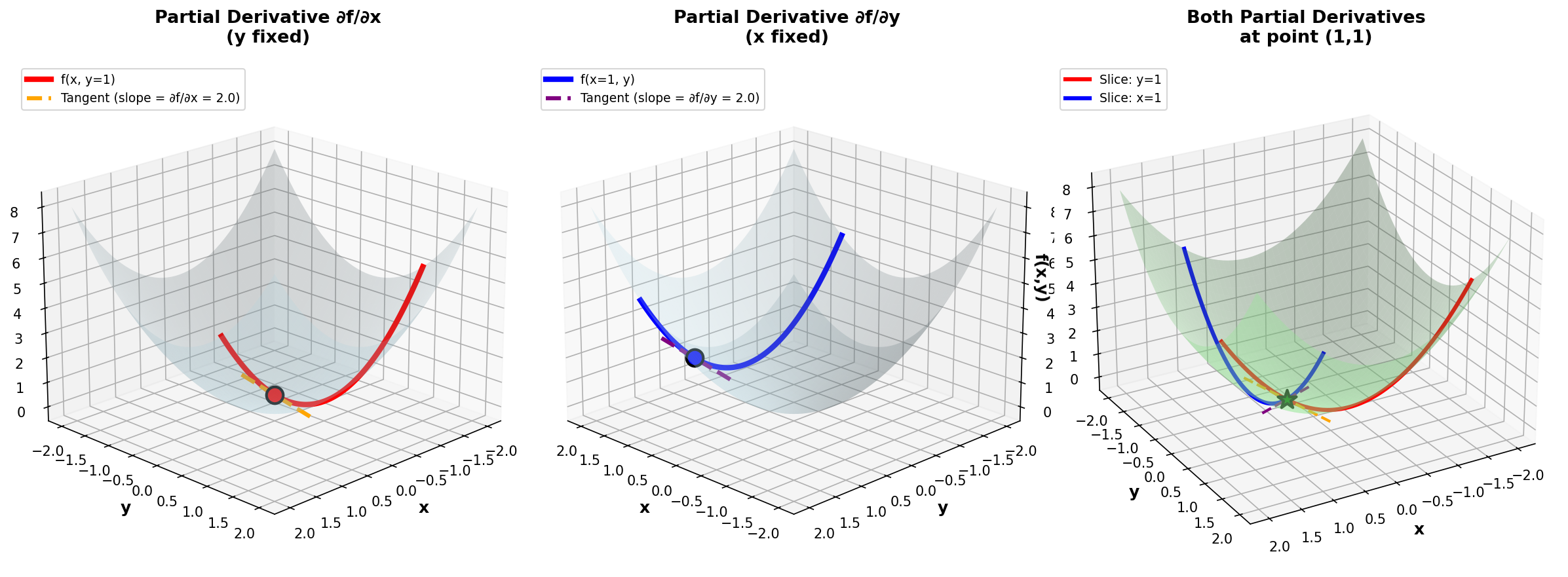
Figure 9: Partial derivatives of f(x,y) = x² + y². Left: ∂f/∂x (variation in x with y fixed). Center: ∂f/∂y (variation in y with x fixed). Right: Both partial derivatives together.
💡 Example: f(x,y) = x² + y²
Let's compute the partial derivatives:
- \(\frac{\partial f}{\partial x} = 2x\) (treating y as a constant)
- \(\frac{\partial f}{\partial y} = 2y\) (treating x as a constant)
At point (1, 2):
- \(\frac{\partial f}{\partial x}(1,2) = 2(1) = 2\)
- \(\frac{\partial f}{\partial y}(1,2) = 2(2) = 4\)
📊 The Gradient
📘 Definition
The gradient is a mathematical concept used to describe the direction and rate of fastest increase of a function.
The gradient gathers all partial derivatives into a single vector. It is one of the most important concepts in optimization!
Notation: \(\nabla f\) is read as "nabla f" or "gradient of f"
🎯 Geometric Interpretation of the Gradient
- The gradient points in the direction of steepest ascent of the function (where the function increases most rapidly).
- Its magnitude \(\|\nabla f\|\) indicates the rate of this increase
- The gradient is perpendicular to level curves (or level surfaces)
- To minimize, we move in the opposite direction to the gradient: \(-\nabla f\)
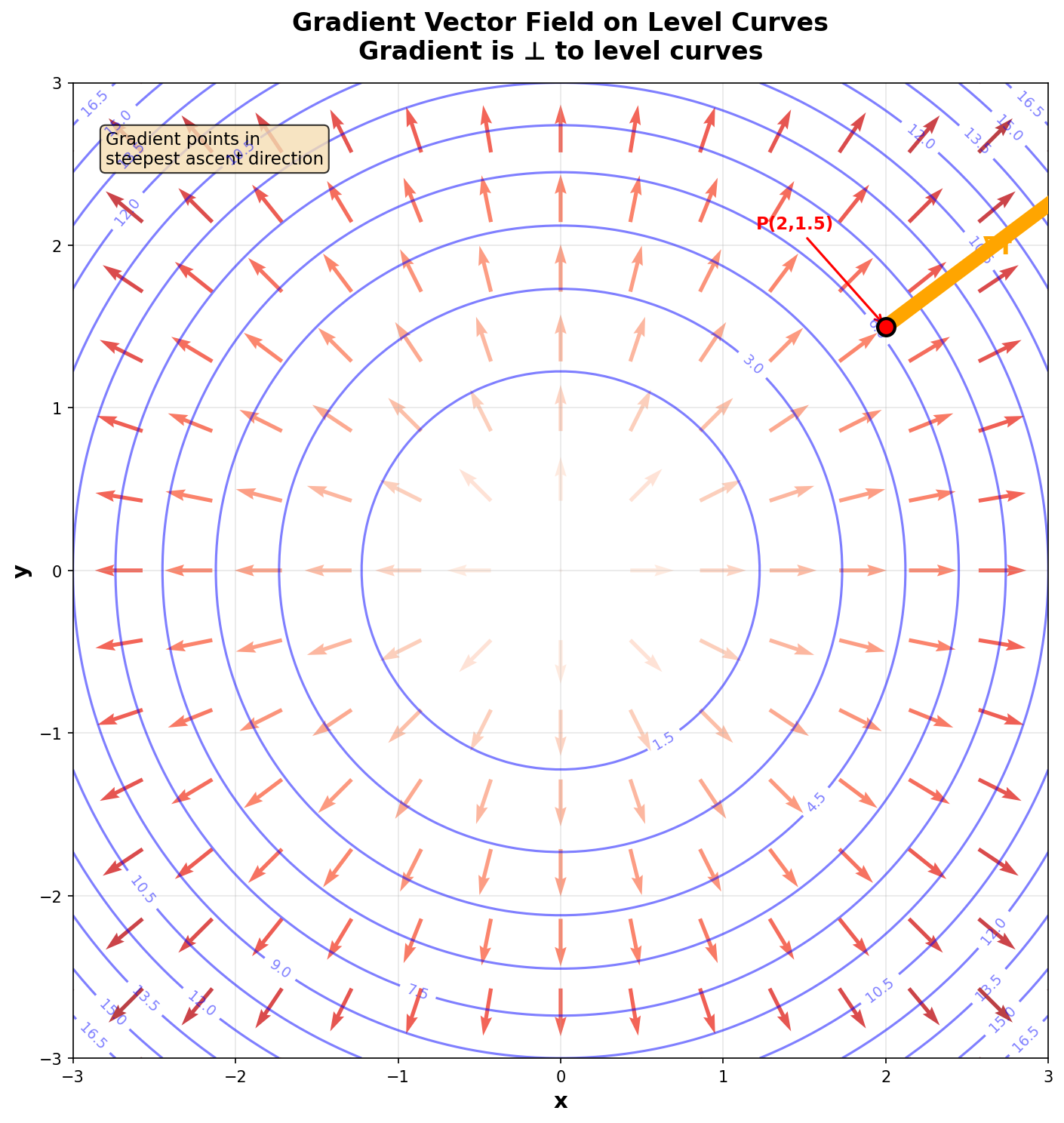
Figure 11: Gradient vector field on level curves of f(x,y) = x² + y². Arrows point outward (upward direction) and are perpendicular to circles (level curves).
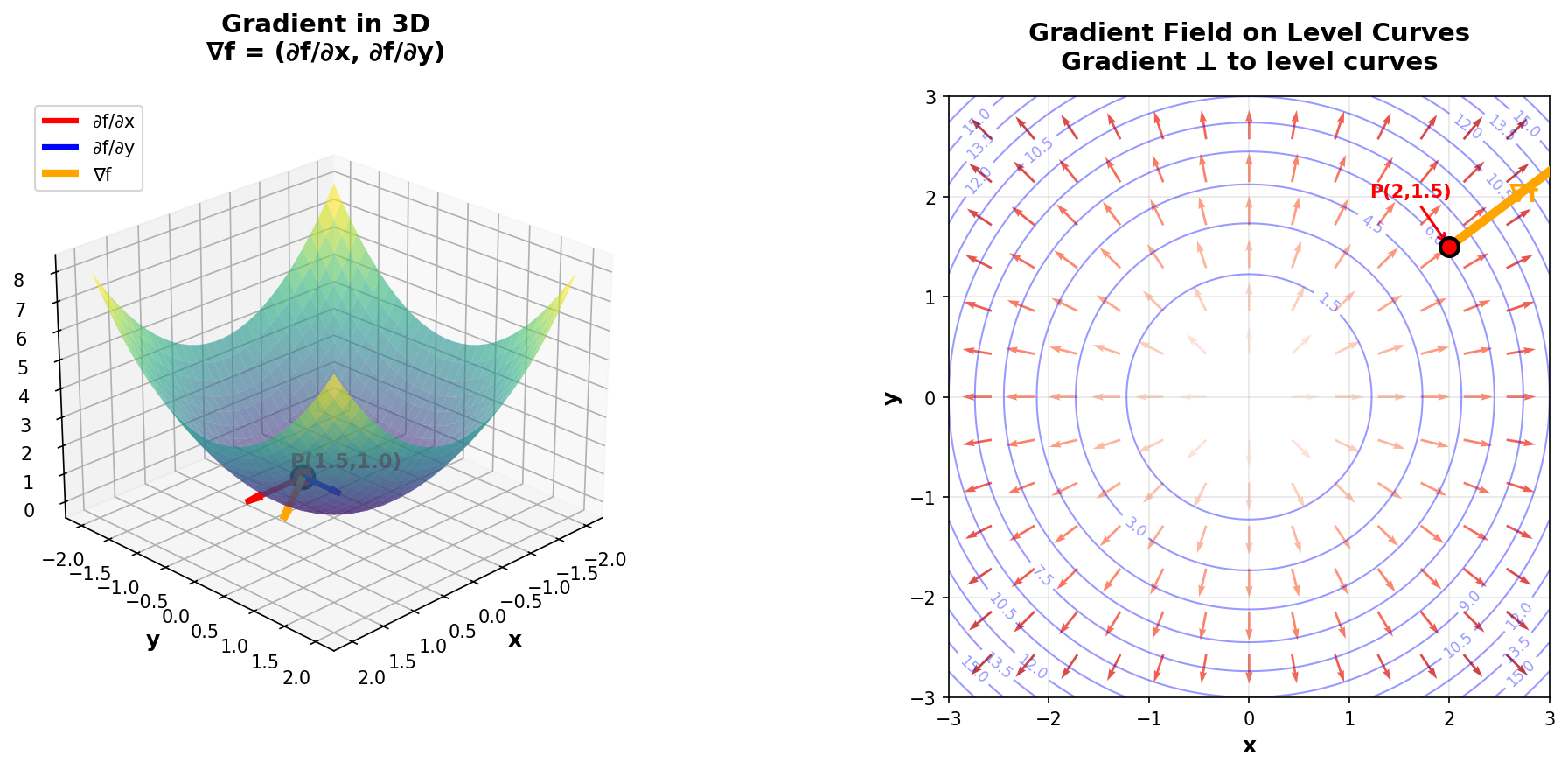
Figure 12: Left: Gradient in 3D showing how ∇f is the composition of partial derivatives (red and blue vectors give the orange vector). Right: Gradient field on level curves perpendicular to contours.
💡 Example: Gradient of f(x,y) = x² + y²
At point (3, 4):
This vector points in direction (6, 8) which is the direction of steepest ascent. Its magnitude is \(\|\nabla f(3,4)\| = \sqrt{36 + 64} = 10\), indicating the rate of growth in that direction.
🎯 Lagrange Multipliers
📘 The Constrained Optimization Problem
We want to:
where \(f : \mathbb{R}^n \to \mathbb{R}\) is the objective function and \(g : \mathbb{R}^n \to \mathbb{R}^m\) represents the constraints.
💡 The Key Idea of Lagrange Multipliers
At the optimal point \(\mathbf{x}^*\), the gradient of the objective function \(\nabla f(\mathbf{x}^*)\) must be parallel to the gradient of the constraint \(\nabla g(\mathbf{x}^*)\).
where \(\lambda \in \mathbb{R}\) is the Lagrange multiplier.
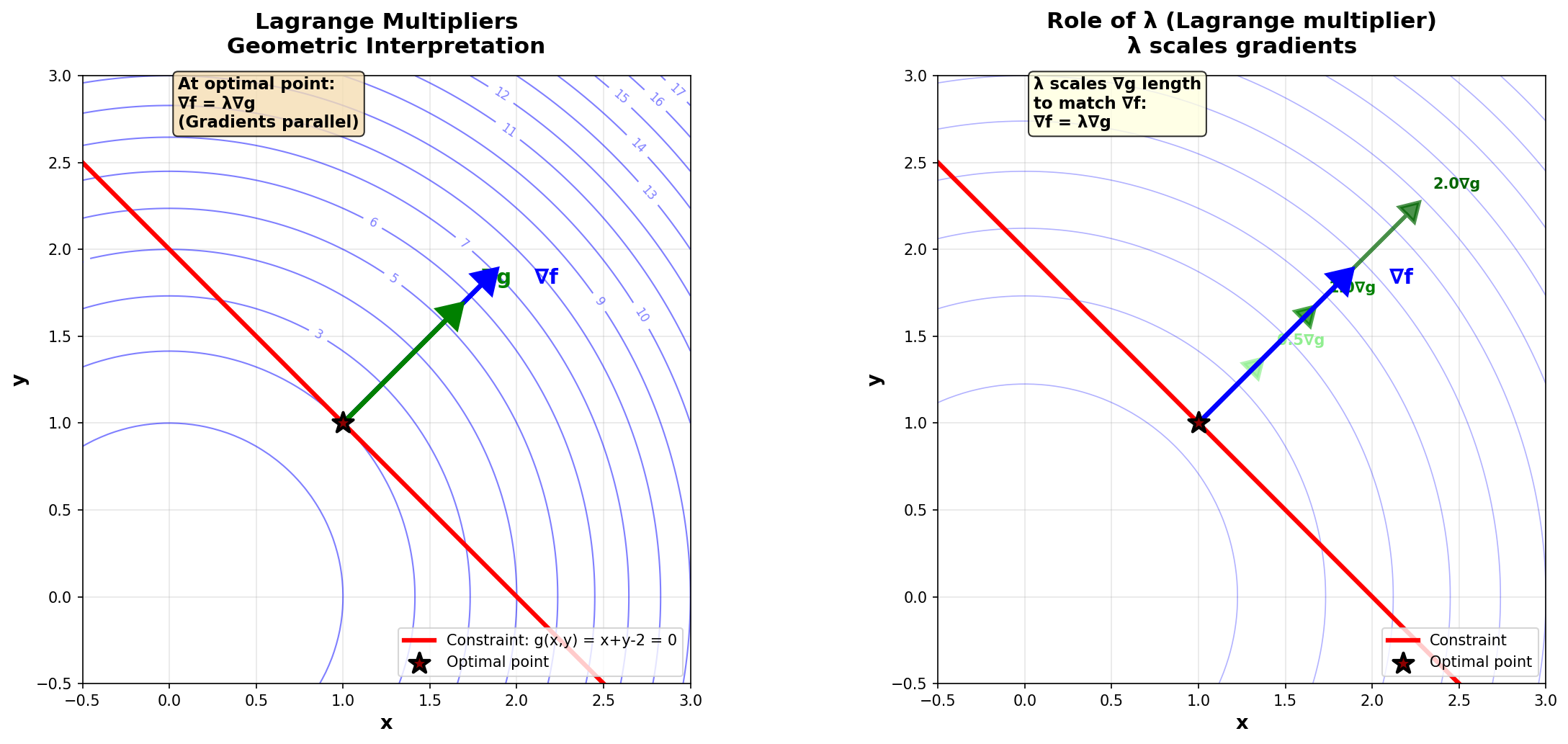
Figure 13: Geometric interpretation of Lagrange multipliers. Left: At the optimal point, ∇f (blue) and ∇g (green) are parallel. Right: The multiplier λ adjusts the length of ∇g to equal ∇f.
📘 The Lagrangian
We define the Lagrange function (or Lagrangian):
The necessary optimality conditions (Karush-Kuhn-Tucker conditions for equality constraints) are:
💡 Complete Example: Minimize f(x,y) = x² + y² subject to x + y = 2
🔍 Economic Interpretation of λ
The Lagrange multiplier \(\lambda^*\) represents the sensitivity of the objective function with respect to the constraint. More precisely, if we slightly relax the constraint from \(g(x) = 0\) to \(g(x) = \epsilon\), then:
In economics, \(\lambda\) is called the shadow price of the constraint.