
1. Laws of electromechanical energy conversion
Electrical machines convert mechanical energy into electrical energy or vice versa. We find:
1. In DC current:
Direct current machines: as a motor or generator (dynamo).
2. In AC cuurent:
- Synchronous machines: as a motor or generator (alternator).
- Asynchronous or induction machines: as a motor or generator.
The energy conversion occurs at a lower efficiency due to losses..
Principle of the energy generator
Take the example of the following figure:
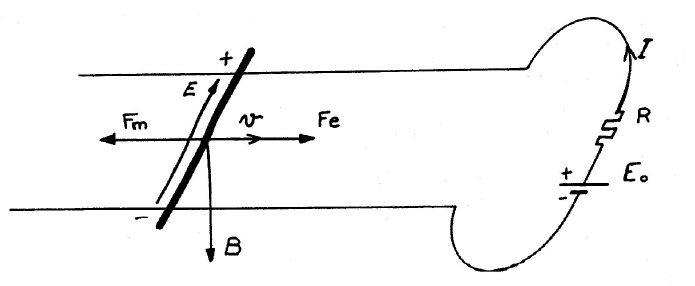
A wire conductor of length L moves at a speed v on two undefined rails placed in a uniform and invariable induction B perpendicular to conductors.
The mechanical force Fm is applied on the conductor and the circuit is supplied by a generator of an electromotive force (e.m.f.) E0 and internal resistance R. We note I as the current with the sign conventions indicated in the previous figure.
Four laws determine the electromechanical system:
- Faraday's law: If the conductor's speed is v, an e.m.f. is created called E :
E = B . L . v
- Laplace's law: If the current in the conductor is I, there is an electromagnetic force Fe given by:
Fe = B . L . I
- Ohm's law:
E0 = E + R.I
- The law of dynamics: if the speed v is constant:
Fm = Fe
At zero resistance (lossless circuit), we find:
* A speed v as: E0 = E
* A current I as: Fm = Fe
Therefore, we can say that speeds are associated to the e.m.f. and the currents to the forces.
The machine is operating in a motor mode if Fe and v are in the same direction (see previous figure). The e.m.f. then is opposed to the current.
If the speed is in the direction of the applied force Fm, we obtain a generator operation mode. The electrical force Fe then is opposed to Fm.
We can express the power at the conductor in a mechanical form or in an electrical form as:

This is called the electromagnetic power.
It should be noted that the energy conversion is perfectly reversible.