
2. Principle of the primitive machine
Real machines with their concentrated or distributed windings and their own geometry are too complex to be analysed taking into account their exact configuration. We must therefore develop for each type a model whose behavior is as close as possible to that of the original.
The general theory aims to analyse a wide range of machines in a unified way by reducing them to a single model called a primitive machine or Kron's machine represented in the following figure.
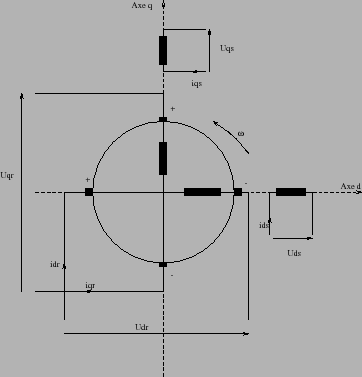
This universal model is characterized by a system of quadrature axes indexed d (direct axis) and q (transverse axis) which is in advance of an angle of π/2 compared to the direct axis, in the trigonometric direction taken as the direction of rotation.
The collector rotor is provided with two sets of brushes, positioned along the axes d and q, which thus determine two pseudo-stationary windings in quadrature. The circulation of currents in the windings of the model causes the appearance of two fluxes φd and φq which induce rotational voltages in the rotor windings. If these fluxes vary with time, they also induce transformation voltages in the rotor and stator windings.
Any electrical machine can be shown to be equivalent to the primitive machine thanks to an appropriate number of windings arranged along the d and q axes (in theory: 2 axes). If, as in a direct current machine, the windings of the real machine are permanently aligned along the axes, this machine corresponds exactly to the primitive machine; otherwise, it is necessary to carry out a conversion of the variables of the real machine to obtain those of the primitive machine.
This conversion involves transforming the windings of the original machine into electrically and magnetically equivalent windings arranged along the d and q axes (phase transformation). This transformation has the effect of making the self and mutual inductances of the model independent of rotation, therefore of making constant the coefficients of the voltage terms provided by the derivation of the totalized fluxes in the voltage equations.
In order to preserve in the rotor windings of the primitive machine the same effects as those due to rotation in the real machine, it is necessary to use the notion of pseudo-stationary windings and to express the rotational voltages by means of mutual rotational inductances. The unified description of the behavior of electrical machines is facilitated by the use of matrix calculation in the form of transformation matrices concerning either the coupling or the frame of reference.
The necessary assumptions about the machines are:
- Sinusoidal structure;
- Symmetrical construction.
Usually, two types of matrix tools are used which are:
- a matrix allowing a three-phase-two-phase transformation (in addition to an homopolar term which does not participate in the energy conversion in a balanced system);
- a matrix allowing a rotational transformation to be placed in a reference frame which simplifies the equations (in d-q frame).