
1- Fuzzy logic:
Fuzzy logic (or fuzzy logic) is a branch of mathematics and computer science that extends the principles of classical logic to better represent imprecision and uncertainty. Unlike classical logic, where a proposition is either true (1) or false (0), fuzzy logic allows intermediate values between 0 and 1.
It was introduced in 1965 by Lotfi A. Zadeh to address complex problems.
2- Linguistique variable:
A linguistic variable is the triplet that links a variable, its range of values, and the set of fuzzy subsets.
2- Fuzzification:
Example: Transport company- Yassir-
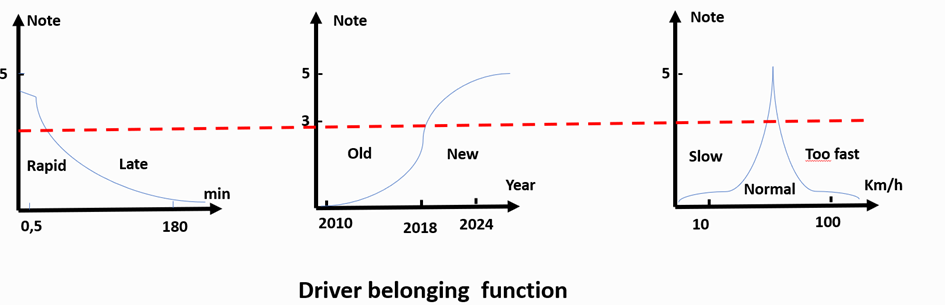
Obtained from a customer rating database.
3- Fuzzy operators:
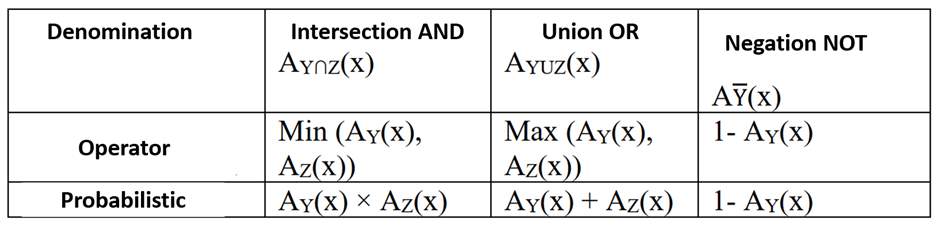
In logic, there are three main operators: negation (NOT), intersection (AND), and union (OR). These operators differ from the classical set theory presented by Zadeh and the fuzzy set theory. The
following table demonstrates the difference:
4- Defuzzification :
We assume that :
- The driver noted by [1,2,3] is « Bad »
- The driver noted by [4,5] is « Good »
- Year > 2018 OR 50 < speed < 60 OR Time > 5 min then note [ 2 , 3 , 4 ]
- Year > 2003 OR 50 < speed < 60 OR Time > 5 min then note [ 2 , 3 , 4 ]
4- Characteristics of a fuzzy set:
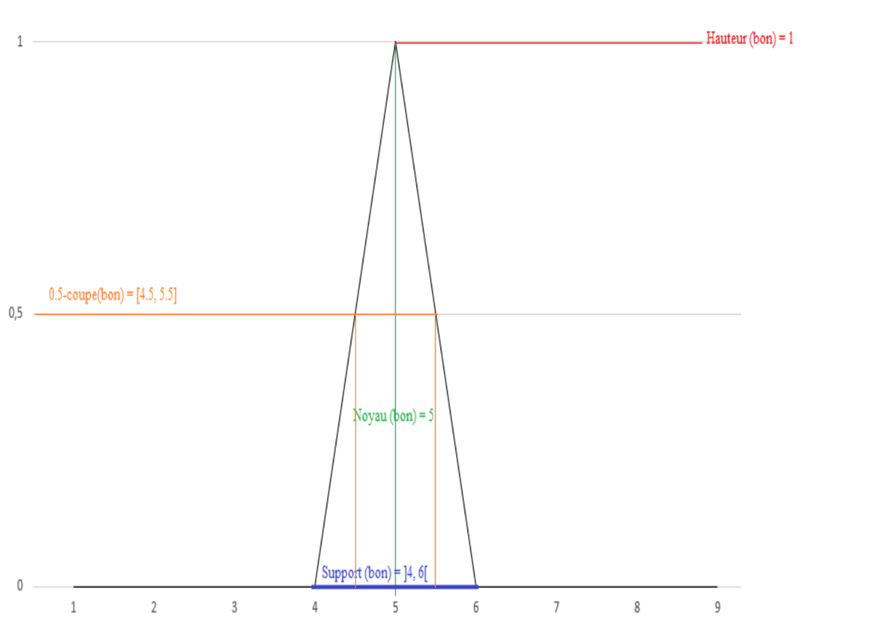
Definition 1: The height of Y, denoted h(Y), is the upper bound of the arrival function of its belonging function: h(Y) = sup {AY(x)|x∈X}
Definition 2: The support of Y is any element x of X from which supp(Y)={x∈X|AY(x)>0}
Definition 3: The nucleus of Y is any element x of X from which supp(Y)={x∈X|AY(x)=h(Y)}
Definition 4: an α-cut of Y is any element x of X from which α-cut(x)={x X|AY(x) α}
5- Characteristics of a fuzzy set:
6- Fuzzy logic applications:
Automation: Control of machines such as washing machines or air conditioners.
Artificial intelligence: Recommendation systems, image recognition and natural language processing.
Medicine: Medical diagnosis based on blurred symptoms.
Robotics: Navigation systems where precise decisions are difficult to make.
Risk management: Assessing probabilities in uncertain environments.
Fuzzy logic is particularly useful when data is vague, incomplete or uncertain. It offers a flexible and intuitive approach to model complex systems.